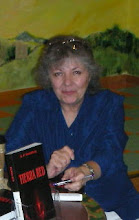
. . . 428 pages of mystery, adventure, and romance at a thrilling roller-coaster ride pace.

Set against the backdrop of territorial days in New Mexico, a Gibson Girl heroine and an unforgettable cast of characters sift through clues on two continents in their search for truth, justice, and love.

Monday, January 18, 2010

Tierra Red is being read in Prescott!


Wow -- we had a marvelous time in Prescott, Arizona this past weekend! Many, many thanks to all the wonderful folks we had the good fortune to meet and, especially, to those fabulous readers who happily purchased copies of Tierra Red.

As promised, a Kindle version of Tierra Red is in the works for those of you who prefer to "hold" their reading material in that manner.

The Prescott Resort and Conference Center is a beautiful venue in a most special historic place. We will treasure greatly the time we spent in Prescott . . . .

Tuesday, January 12, 2010

Tierra Red 'On the Road Again' . . .

With the holiday season behind us, we start anew with book signing dates in 2010. Our first stop this year will be the Kiwanis Midwinter Conference at the Prescott Resort Conference Center in Prescott, Arizona. Our table will be open from noon until 6pm on Friday, January 15th and from 8am until 5pm on January 16th.

We would love to see you there . . .

Friday, October 16, 2009

New Mexico Magazine Review

A huge thank you to Ashley Biggers of New Mexico Magazine! Her wonderful review of Tierra Red appears in the November, 2009 issue -- the photo of the cover at the right will take you directly to the magazine's website and the review.

Friday, September 11, 2009

Tierra Red Book Signing Date

Yep, we have another one this week in one of my favorite locations in New Mexico -- Ruidoso. An early portion of Tierra Red takes place on the western slopes of Sierra Blanca Mountain. Ruidoso is on the eastern side in one of the prettiest valleys in the whole world.

Come join me at Atticus Books & Tea House from 2-5pm!

Big Thank You to Tome on the Range!

Last Saturday was a wonderful experience -- the book signing in Las Vegas, NM was a smashing success! We had a lively crowd which made for a great discussion time.

This bookstore is a must-see if you are ever in northern New Mexico!


Monday, August 31, 2009

Tierra Red Book Signing Date

Getting ready for our visit to northern New Mexico this weekend. Our next book signing is scheduled for September 5th at Tome on the Range Bookstore on the plaza in Las Vegas, NM from 3:00 to 5:00pm. Hope to see you there!

This is an especially exciting book signing since most of Tierra Red takes place in and around the Las Vegas community.

Thursday, June 25, 2009

Hastings Book Signing on June 20th


Can you tell just how much fun we had at this book signing the day before Father's Day? Hastings Books in Las Cruces was a very, very busy place!


I hope all those fathers who received a copy of my book enjoy the read . . . .

Friday, June 19, 2009

Tierra Red Book Signing News


Our first book signing was a lot of fun. COAS Books certainly knows how to make a body feel at home. In a few days, Hastings Books in Las Cruces will be hosting a similar event for Tierra Red.

We are in the process of establishing the schedule for this summer. Latest news is that we will definitely be at Tome on the Range Bookstore in Las Vegas, New Mexico on Labor Day weekend. As soon as the date has been established for Atticus Books & Tea House in Ruidoso, it will be published here, too.

Haven't meant to be so neglectful of posting historical points for Tierra Red. Look for a few new posts this weekend.

Wednesday, June 03, 2009

Tierra Red Book Signing Dates

Now that my federal court jury duty time has come to an end, we finally have the opportunity to do our first book signings for Tierra Red. The wonderful folks at the following bookstores have set up the following for June:

Saturday, June 13th -- 10am at COAS Books, Downtown Mall, Las Cruces, NM

Saturday, June 20th -- 12noon at Hastings Books, 2350 Lohman, Las Cruces, NM

The cast of characters and I are looking forward to meeting all of you!

Saturday, April 11, 2009

Tierra Red Historical Point: White Sands Desert


The largest pure gypsum dune field in the world is located at White Sands National Monument in south-central New Mexico. The dunes cover an area of 275 square miles, 115 square miles of which are located within the White Sands National Monument. President Herbert Hoover proclaimed and established the monument in January, 1933.

Lily's harrowing escape from the catastrophic events that occur in Part One of Tierra Red culminates in her being stranded in these dunes. It is here that she discovers the treachery behind her arrival in the Territory of New Mexico.


I found a wonderful old legend concerning the White Sands Desert on the National Park Service website -- a ghost story!

The Legend of Pavla Blanca


To the Indians of central New Mexico, one of the most enduring legends is that of Pavla Blanca, the ghost of the Great White Sands. Hidden behind the swirling eddies of the spectral white dunes, her tragic story provides one of the most fascinating tales of the Southwest.

In early 1540, a valiant, young Spanish conquistador, Hernando de Luna, left his lovely betrothed, Manuela, in Mexico City to accompany the famed explorer, Francisco Coronado. Searching the uncharted lands in present day Arizona, New Mexico, Kansas, and Texas, Coronado followed every Indian clue, every tale, looking for the fabled Seven Cities of Cibola and Gran Quivira, where the houses were said to be studded with gold and the streets were afire with jewels.

Ambushed by the fierce, proud warrior Apaches on the edge of the Great White Sands, the Spanish battled for their life. Exhausted and beaten, the survivors fled southwest to Mexico City. It is said that Hernando de Luna was mortally wounded and perished somewhere in the ever-shifting white sands. Setting out to seek her betrothed somewhere north of what is now El Paso, Texas, the lovely Manuela was never seen again. It is said that the ghost of this beautiful Spanish maiden haunts the dunes of the Great White Sands. She comes nightly in her flowing, white wedding gown to seek her lover, lost and buried beneath the eternal dunes. Some say the ghostly figure usually appears as the evening breezes sweep and dip over the stark white dunes, just after sunset.

The moderns have it that Pavla Blanca is caused by a prevailing wind sweeping over the hushed and lonely desert in the evening, whipping wraith-like eddies of dust. But the Indians say it is the ghost of Manuela, still eternally seeking her lover.

Fact or fiction, those with imagination, strolling in the silent shimmering dunes after a fiery sunset may be fortunate enough to witness for themselves the unusual sight. Thus, this legend persists for some, even to this day. This is Pavla Blanca.

Wednesday, April 08, 2009

Tierra Red Historical Point: Stagecoach Travel

Although much romanticized by Hollywood, actual stagecoach travel was far from glamorous. These snippets from the archives of the San Diego Historical Society depict the true story:

The inconveniences of our modern modes of travel are nothing compared to what passengers in the 1800's endured when traveling on bad roads in harsh weather which often made the stage coach run an exciting experience. The San Diego Union reported a typical incident in February, 1883:

"Frank Frary, who drove the Julian stage in last evening, says that when he started yesterday morning the wind was blowing a perfect hurricane from the east and northeast. The stage swayed so violently in the gale, that fearful that it would capsize, he and the two passengers piled two or three hundred pounds of rocks into the vehicle as ballast, which they carried until the grade had been passed."

Katie Leng offered insight to our modern world about stagecoach travel in a 1972 interview for the San Diego Historical Society. Leng, whose uncle ran Foster's Station, recalled the stages were:

" . . . miserable things to ride in. Let me say that the stage coaches galloping along in the Western movies always upset me, because it wasn't that way at all. The horses were trotted, with frequent breathers. Also, there was only one man on the box, and I never knew of any of them being armed. They wore any sort of clothing they wanted to, nothing flamboyant. We never had a hold-up. The only real tragedy I ever heard of was once, before my time, a driver was leading his team across a usually dry wash and was caught by a flash flood and drowned."

Sunday, April 05, 2009

Tierra Red Historical Point: Las Cruces


Tierra Red takes place during the years 1898-1900 in the Territory of New Mexico, featuring the Las Cruces, Las Vegas, and White Oaks areas.


Las Cruces has two historic districts: the Alameda-Depot District and the Mesquite District. Both districts are listed in the National Register of Historic Places.


The major streets of town were those running north-south, perhaps because the route of travel and commerce (Camino Real or Chihuahua Trail) ran in that direction. These streets were wider than the cross streets and were named Water (it fronted the irrigation ditch), Main (the business street), Church (location of the Catholic church and its plaza), Campo (for the camposanto or cemetary, Mesquite (for the desert shrub that covers the hills), and Tornillo (at the back of town, not named in the original platting.

Las Cruces was platted in 1849 on the hills south of several graves that served as a landmark for travelers, marking a crossroad and a place to cross the Rio Grande. The area became known as El Pueblo del Jardin de Las Cruces (City of the Garden of Crosses).

History tells us that a U. S. Army Lt. laid out the town in 1849 using nothing more than a rawhide rope with which he marked off the city's new streets. The heads of families took turns drawing a chance from a hat to determine which property they would own.

Lily's story begins in 1898 in this community, nearly fifty years later.

Monday, March 16, 2009

Book Club Discussion Guides

We have received numerous requests for a discussion guide for Tierra Red. This guide will be posted later this week and I will try to set up a button link for a downloadable copy for printing in the right-hand column of this blog.

In the meantime, our heartfelt thanks to all those who have ordered the book so far and their lovely congratulatory wishes.

The next Historical Point will be posted in a few days . . . .

Monday, March 09, 2009

TIERRA RED is now published . . .

To say it has been an exciting six days since Tierra Red was published last Wednesday is not the half of it! Waiting for my author's copies to arrive has been excruciating . . . .

When you roll your mouse over Lily's face now, you will find that it links to an author's webpage with further links to Barnes & Noble, Amazon.com and an ebook format.

Each week I will begin posting character studies and more historical points from Tierra Red. There is such a wealth of historical information surrounding this story that we will run out of weeks before all of it can be told.

Stay tuned for some fun contests, too . . . .

Sunday, March 01, 2009

Tierra Red Historical Point: Land Grants

(1895 U.S. Atlas - Territory of New Mexico Map)


The mystery at the heart of Tierra Red involves stolen land grants. Remarkably, this issue is still a deep controversy in the state of New Mexico today. As recently as 1999, Senators Pete Domenici and Jeff Bingaman of New Mexico introduced legislation in the United States Senate to initiate renewed investigation and restitution for hundreds of ignored claims.

To gain a better understanding of how the issue of land grants affected the forming of the Territory of New Mexico, the following excerpt from the Historical Atlas of New Mexico by Warren A. Beck and Ynez D. Haase (1969) offers some insight.

The United States adopted the rectangular system of public land surveys in 1785. The system was based on the manner in which old town grants had been made in early Massachusetts. The new rectangular plan was intended to make settlers take all of the land instead of the choice parcels only, to provide an orderly method of recording land titles, and to describe titles in such a way that duplication would be avoided.

When the United States acquired the Southwest in the Mexican Cession of 1849, it inherited a very confused system of land tenure, which was at its worst in New Mexico. In the two and one-half centuries of Hispanic occupation, land was acquired most informally. In fact, the Hispanic manner of granting land title was anything but an exact science. Many landholders did not even possess the legal documents required to prove their ownership. Others had titles which described their holdings in such vague fashion it was impossible to define boundaries. It was common to use streams, hills, rock, or even trees to mark land division. Then, too, frequent transfers of titles or subdivisions were not properly recorded.

Under the peace treaty with Mexico in 1848 the United States government assumed the responsibility for certifying land titles which had existed previous to that date. In order to determine the extent and legality of these holdings, both public and private, which had been acquired under Spanish and Mexican rule, a control point had to be established which would permit land surveys that would be meaningful under the surveying system of the United States.

This control point was established in April, 1855, by John W. Garretson. He fixed the Initial Point on an isolated hill on the west bank of the Rio Grande not far from the Mexican village of La Joyita in Socorro County. From this point he ran the Principal Meridian of New Mexico south to the International Boundary and north 96 miles. The Base Line was run 21.5 miles west and 24 miles east of the Initial Point. A Guide Meridian and five Correction Lines were then run out. After this, an orderly program of cadastral or property boundary surveys were made.

Most of the early township surveys were made on grant lands in an effort to help establish proper title. Unfortunately, the court operated much more slowly than did the surveyors, and it took years in many cases to prove legal ownership.


Sunday, February 08, 2009

Tierra Red Historical Point: 1895 U. S. Atlas


Pam Rietsch at http://www.memoriallibrary.com/ has spent years creating jpgs of every page of this antique atlas. I discovered her website nearly ten years ago while doing research for Tierra Red.


The composite map shown above is from the Part One divider page in Tierra Red. Since Pam has created jpgs of each individual county of the Territory of New Mexico, I used segments of three jpgs to create an image which shows the incredible distance Lily traveled during and following the catastrophic event that occurs in Part One.


Anyone who has traveled through New Mexico in modern times understands the enormous size of this state which covers 121,666 square miles, making it the fifth-largest state in the Union.


But this segment of Lily's journey is only the beginning . . . .


Sunday, January 18, 2009


Awesome!


Dover Publications has graciously given the okay to use this gorgeous image in TIERRA RED.

I am so excited -- this piece of clip art sat next to my computer through all the years of writing and editing this novel.

She has become the only representation of Lily, the heroine, in my mind. I just wish Charles Dana Gibson was still alive so I could personally thank him!

Thursday, January 08, 2009

Exciting news for TIERRA RED is coming soon!

Thursday, September 13, 2007

2007 All Dolled Up: Beaded Art Doll Competition -- Short Story

(Opening paragraph was mandated by the competition)


The Forbidden Quest


Blues, whites, fiery reds and yellows -- overtaking the sky from dusk 'til dawn -- fascinate me, whether in my dreams, or longings for that something more, whirling nebulas, mysterious planets and stars I barely see -- my Beaded Art Doll, my celestial reflection, I name you . . .

Galilea.


She stood on the rim of the Yshtan Crater as each moonrise left the horizon, waiting for the ninth moon to appear. She prayed that the astral winds would be favorable. It was the eve of the Prime Solstice, the only night possible to view her sacred object, and her telescope stood ready at her side.


When the ninth pale moon broached the horizon, Galilea's heart quickened. She placed a hand on her chest and took a deep breath. Everything depended now on the astral winds. Her theory would be scoffed at once again if she could not produce evidence of her find. Her very existence would be threatened if she failed in this endeavor, for the Kaeloan Council had forbidden her to search the universe for an object that could not possibly exist.


As the ninth moon reached its zenith, a cold wind began to flow around her. Galilea shivered, more in anticipation than from the chill. Patiently, she watched as the veils of cosmic debris lifeted and afforded a pristine view of the universe that lay beyond her own star. The astral winds seemed stronger tonight and she was nearly overcome with the breathtaking sight that unfolded above her.


Galilea focused her telescope on a distant galaxy, searching for the rare blue planet that she must prove existed. She had armed the telescope with a special device meant to gather that proof and she tempered her eagerness to trigger it until the exact moment the planet came into view. When she located the star at the core of the galaxy, Galilea began a slow sweep of the millions of objects swirling around it. Though many of these objects were much larger than the one she sought, none of them exhibited the qualities necessary for life to exist.


At last, she found the blue planet. Galilea steadied the telescope and prepared to trigger the device attached to it. Behind her, she heard threatening voices and shouts above the din of the terrestrial vehicles climbing the road to the rim of the crater. The Kaeloan Council began to storm the rim.


Galilea stood fast and defiantly took another sighting through the telescope. Confidant that the blue planet was still in its sight, she fired a beam directly at it. The beam captured the blue planet and returned a holographic image of it to her outstretched hand. As the blue planet turned on its axis, white clouds swirled across the poles and the outlines of land masses and blue oceans. The planet's atmosphere shimmered in the palm of Galilea's hand.


The members of the Kaeloan Coucil gasped in recognition of what Galilea had done. She had proven that another planet existed where life was a real possibility. Although they had searched the universe for thousands of years, no other planet had been found with such characteristics. They had given up hope of ever finding life on another planet.


Galilea was a woman of vision and persistence. She was not daunted by narrow thinking or threats. She refused to believe that life could not exist somewhere else out in the vast reaches of the universe. She smiled as she watched the holographic image turning in her hand, and mused what name to give this wondrous orb.


*****


Galileo Galilei was a man of vision and curiosity, so much so that he nearly gave his life to explore the unknown universe. He was forbidden to publish his findings and threatened with death while living in an age which was dominated by austere philosophies. Although his telescope was barely adequate, what he did manage to see beyond the atmosphere of our planet Earth convinced him that the heavens held boundless mysteries to explore and that our planet was but a mere inhabitant of a greater space than one could imagine. He was the first astronomer to study the sun and map the sunspots he saw moving across the sun's surface, observe the moon's craters and Jupiter's satellites.


Who, today, could view the magnificent Hubble photos of the universe without feeling overwhelmed with curiosity and wonder? Who could not be in awe of the photos of millions of stars moving in mysterious configurations deep in the vast blackness of the universe? Galileo would have been thrilled to witness all the recent discoveries made through these photos.


Galilea is a tribute to Galileo, her head adorned with the golden radiance of our Sun. The upper portion of the front of her gown displays one of the most recent stunning astronomical discoveries, the hot star MWC922 -- the Cosmic Red Square -- a distant bipolar nebula exploding in near perfect symmetry in the constellation Serpens. The three major stars of the Hunter's belt in the Deep Orion Field of the Orion constellation adorn the lower portion of the front of her gown, Alnitak, Alnilam, and Mintaka -- brilliant blue supergiant stars that mark the night sky from late August through mid-January. The Pleiades star cluster, also known as the Seven Sisters, fills the backside of her gown. It is one of the most conspicuous objects in the night sky that is among the first to be marveled at when we are children. The faintest star in this cluster is still 40 times brighter than our own sun. The brightest star in this cluster, Alcyone, is 1000 times more luminous! Cosmic debris such as the veils that Galilea's astral winds disburse can be seen in the vicinity of the Pleiades -- clouds of minute grains of interstellar dust.


This doll is also a tribute to the men in my life who have fostered and shared a love for exploring the night sky and universe around us. My father who patiently taught all of his children about the wonders of the night sky. He died many years before the Hubble telescope was launched but he would have become as much of a Hubble photo junkie as I have become, excited beyond measure by each new discovery and enchanted by all of the discoveries. He would have been in awe of the vast numbers and shapes of galaxies that have been documented to date as indeed I am. And my dear husband, who lovingly indulges me with every Hubble photo book that is published, reads every email link to yet another Hubble discovery that I send to him, gifts me with the annual Hubble photo calendar -- and who humors my childish delight over each new Hubble photo.


Galilea prompted me to think of many things while she was being created. She evoked memories of nights spent in star dreaming and days filled with yearning to know more about the universe. She also kept whispering lines to me from one of my favorite poems by Robert Frost:


Earth's the right place for love: I don't know where it's likely to go better.


Wednesday, June 20, 2007

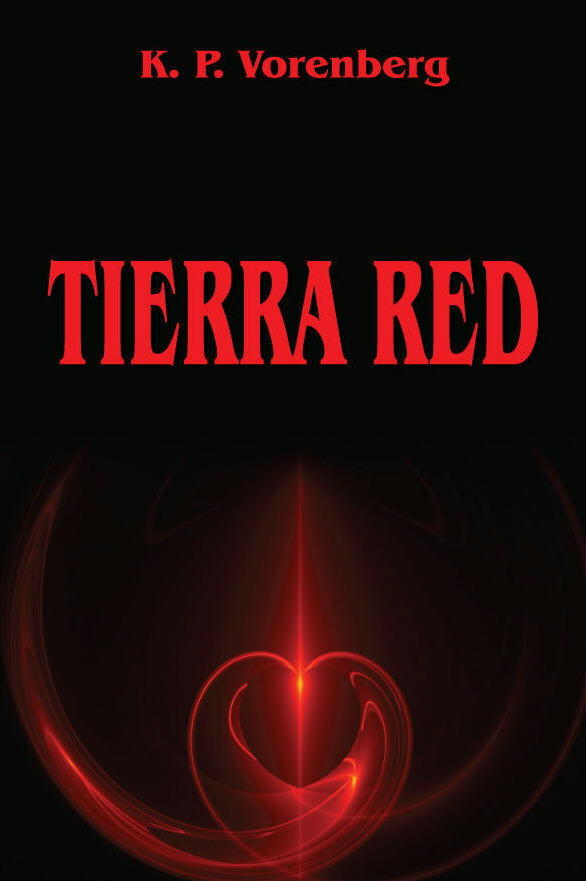
Tierra Red is on its way to the 2007 Hillerman Mystery Competition.

After living with this manuscript for seven years, it feels almost like sending our youngest daughter off to graduate school three years ago. A mixed bag of emotions -- excitement, anticipation, and hopefulness -- and a little bit of anxiety today. Tierra Red has become every bit as much a child of mine as our real-life six children.

November 1st seems so far away right now . . .